3 Jan 2011

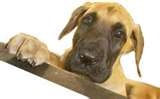
Acne in Danes


What can I do?

From my experience I have noticed that Acne can come from a few things such as the food/water bowls aren't clean on a daily basis, the dog food isn't agreeing with their system, they like to play in the dirt a lot and are not wiped down immediately, or they like to eat poop and their chin gets messy.  I am sure there are other things that may cause this, but like I said this is from my experience and talking with my vet.


The way I got rid of the problem was first getting antibiotics from my vet and then trying to keep the bowls and their faces as clean as humanly possible, feed a very good food (that has less fatty meat  content), and try to keep their faces as clean as possible.

Manuka honey works here too but if you have other dogs in the household they will lick it off as it is rather yummy to them. I give a tablespoon each night if really bad and smother over the face. 

Most pups and young dogs out grow this as they reach adulthood. 

18 Dec 2010

Breed Standard (Photo)


1 Nose 
2 nasal bridge
3 Lips 
4 Stay
5 Cheeks
6 Skull
7 Throat 
8 Ears 
9 Neck
10 Nape
11 Withers
12 Back and loin
13 Croup
14 Pelvis
15 Set of the tail
16 Tail
17 Forechest 
18 Ribcage
19 Breastbone 
20 Shoulderblade 
21 Upper Arm
22 Elbow 
23 Forearm
24 Carpal joint
25 Pastern
26 Toes
27 Penis
28 Upper thigh
29 Patella
30 Lower thigh
31 Point of the hock
32 Hock
33 Rear Pastern


19 Nov 2010

All the mantles

Express

Express 

Merci I know its American but I liked it

Rolex 

Kismet and Tuxedo

Geronimo 

Helmut

Major

Xaver

Xaver

Stripe 


All these pics are in the public domain or I have been granted permission to post them. 


24 Sept 2010

Mantle Great Dane

Our homebred Mantle
Culseandanes Viper's Tale 
aka Stripe.

A few Mantle facts

Mantles are strictly Black & White.

They cannot have any Merle (grey) on them Otherwise they would be considered a heavy marked or blanketed Harlequin or classed as a missmark

Some parts of the world still refer to this colour as Boston.

Mantles often come from Harlequin breedings.

Mantles can be bred to Harlequins and it can reduce the risk of whites in the litters. 
(do check your dogs ancestors for this though as Great great great grandparents may surprise you.)

Mantle bred to Mantle cannot produce Harlequins. 

Mantles where only allowed into the show ring in 2007. Some show side folks and breeders where not happy about this but most have come round. 


courtesy of sixstardanes.

This is ones in the ring and 1 being the most favourable for conformation and markings. 
As you can see Stripe fits the bill just a tad on the small side for my liking.  

------------------------------------------------------------------------------------------------------------------
This from the American side they got to have a mantle in the show ring long before us as usual.


To All Dane Fanciers: We have official notification from AKC of final approval and effective dates for the addition of the mantle class at AKC shows. The memo, dated March 11, 1999 was sent from AKC's Robert Pio, and states the mantle dog standard, as amended, was approved by AKC and is effective 4/28/99.

1. Premium lists already printed with classes by color: Secretaries and Superintendents are to ACCEPT entries with a designated color, "Mantle".
2. For upcoming shows, premium lists presently or not yet prepared: ADD mantle to the list of acceptable colors where the classes are divided by color.
3. All Judges Books and Catalogs should reflect this additional class division, where appropriate.


Here is the final wording of the revision to the Great Dane Standard:
******Mantle******
The color shall be black and white with a solid black blanket extending over the body; black skull with white muzzle; white blaze is optional; whole white collar preferred; a white chest; white on part or whole of forelegs and hind legs; white tipped black tail. A small white marking in the black blanket is acceptable, as is a break in the white collar.
*******
Any variance in color or markings as described above shall be faulted to the extent of the deviation. Any Great Dane which does not fall within the above color classifications must be disqualified.

I am greatly appreciative of everyone who worked so hard to get this change approved. I think it will be very exciting to see these beautiful dogs assume their place in the show ring.


25 Aug 2010

Harlequin Great Dane

Mandisadane Lady From Culseandanes 
aka Wilma


    A few Harlequin facts

Great Danes are the only breed of dog with this colour pattern

When Harlequins are bred together they may or may not produce Harlequin puppies

Harlequin bred to Harlequin can produce White puppies that frequently are deaf and/or blind

Harlequins are frequently mistaken by the general public as Dalmatians.

25 Sept 2009

PUPPY PACKS WHATS IN YOURS


KC REG PAPERS SIGNED FOR TRANSFER.

5 GEN CERT.

WORMING INFO.

CONTRACT READ THROUGH AND UNDERSTOOD AND SIGNED.

I HAVE 2 ONE FOR PETS ONLY AND ONE FOR SHOW DOGS. 

INOCULATION CARD  ALL PUPS HAVE ONE JAB BEFORE LEAVING 

MY PUPPY DIARY/BOOKLET
(FULL OF INFORMATION)

TATTOO INFO AND TRANSFER PAPERS SIGNED OR
MICROCHIP INFO AND CHANGE OF NAME PAPERS 

FIRST COLLAR

SECOND COLLAR MAYBE IF FIRST IS TO SMALL.


2 LITRES OF WATER IF GOING FAR IT SAVES UPSET TUMMIES. 


ALL LEAVE WITH A COLLAR ON.

BLANKET

TOYS ONE HARD ONE SOFT.


11 Aug 2009

Orgins of Our Great Danes


Shrouded in myth the real origin is obscure but historians will tell that man has since early times kept giant smooth coated hounds.  There are paintings, tapestries, statues and coins that depict these facts.  As these civilisations traded goods the prize hounds were also amongst the items that travelled along the trade routes.  So we have evidence that these hounds were wide spread in the areas we know as Poland, Russia, Germany, England and France.  The Romans, Assyrians, Greeks and Egyptians all played their part in this episode.


It is to middle Europe, particularly Germany, that the development of the modern Great Dane can be attributed.  England also played its part in no small way as the Anglo Saxons kept giant hounds, and with the Roman conquest these highly prized hounds were exported to Rome.

In Germany the northern hounds tended to be a heavily built dog.  In the south the hounds tended to be built on much finer lines.  Many of the big cities had also established their type, some that come to mind are Stuttgart, Ulm, Berlin, Hamburg and Württemberg all producing  their own  traits and type.

Important steps were made in Germany after the war of 1870, when it was decided there should be a national dog, the Deutsche Dogge.  The aim was to produce a giant hound upstanding with strength in head, body and bone.  The various traits of the established hounds were mixed and by selective breeding the foundation of the modern Great Dane was produced.  The gathering together of the interested breeders formed the first dog shows.  This led to a standard to judge by (probably the first was Herr Scheidoberg’s standard).

Records of breeding came along so interested parties would have first hand knowledge of the pedigree of the dogs they were interested in breeding from.

Around 1874 an important breeder, Max Hartenstein, acquired a dog from the Stuttgart area of Germany.  He named him Bosco and by 1876 he had purchased a bitch Bella, and from this pair he bred many Fawns, Blacks, Brindles and Harlequins.

Another important pioneer of the breed, Mr E Mebter, formed his kennel in Northern Germany, and between 1880 and 1890 was exhibiting large numbers of Danes.

In the South the influential breeder, Mr B Ulrich, was establishing his influence, perhaps his best years were between 1882-87.

A fourth influence was the breeding in 1886 in the Berlin area of Mr Aichele's kennel of Schwalbennest Danes, which in the main were blues.

In 1888 came the formation of a club devoted to the breed.
At the turn of the century it must be noted that many of the dogs from Wurttemberg were sold and exported to England and France.